Tag Archives: Graham Chapman

The Graham and Terry Show

32 years ago this week Terry Gilliam and Graham Chapman appeared on Late Night with David Letterman for the premiere of the film of Monty Python Live at the Hollywood Bowl.

Image

And now, just 32 years later, another live Python performance! #pythonspamclub #montypythonlive

Coconuts and Pythons…

I just realized that this is a rather significant week for me as a Monty Python fan.

It was 39 years ago, on June 8, 1975, that I drove to Carnegie Theatre, accompanied by my pal Steve Wolf, for the Chicago premiere of Monty Python and the Holy Grail.

It was also the first–but hardly the last time–that I would be up close and personal with a Python.

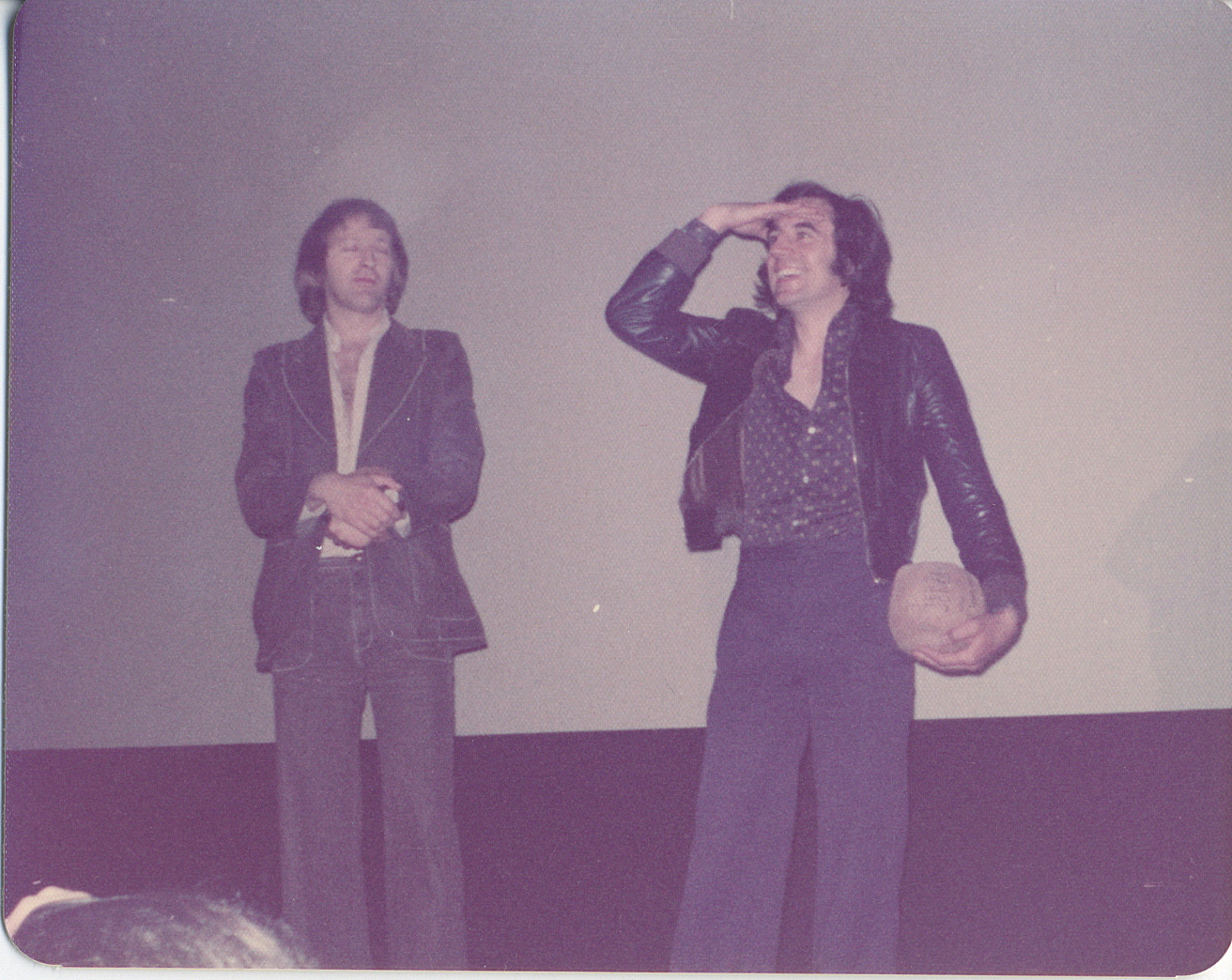
Graham Chapman and Terry Jones were appearing in person at the theatre, so there was no way I would miss it. We were there several hours early, and were rather close to the front of the line. The theatre was giving out free coconuts to the first few hundred people in line, and we didn’t want to miss out. I also wanted to make sure I would be as close to Graham Chapman and Terry Jones as possible.

When they opened the theatre, we grabbed our coconuts and rushed to the front row. Perfect seats for seeing the two Pythons up close (although not necessarily the best seats for watching the movie, as we soon found out).

Image

The theatre manager came out and introduced Graham and Terry, who came out to riotous cheers and applause, talked to us a bit, and then took a few questions. I came forward and presented the two of them with a pair of carved coconuts to commemorate their Chicago visit (which, although I never asked, I’m sure were immediately deposited in the dumpster behind the theatre).

Image

It didn’t matter. Steve snapped a picture of me with the two of them, and I was delighted (though in retrospect, I’d have foregone the knotted handkerchief I was wearing). Nevertheless, it would be, as they say, the beginning of a beautiful friendship.

Nine years ago this week–on June 5, 2005–Monty Python’s Spamalot won the Tony Award for Best Musical (as well as awards for Mike Nichols and Sara Ramirez for Best Director and Best Actress, respectively). Since that time, it has played, literally, around the world many times over, and has shown no signs of ending. This is a mini-documentary about the rehearsals for the original London show, which includes a few familiar faces in addition to the cast (which is impressive enough, and includes Tim Curry recreating his original role of King Arthur). Yes, I know Graham Chapman was originally King Arthur, but Tim Curry is a much better singer. Take my word for it. And enjoy.

Lousy Python Song

And this seems to be a good time to post the brand new old Python song and video, originally written for “Contractual Obligation Album,” thanks to Eric Idle and Graham Chapman!

Python Singing Again

In early December of 1989, I was in London for the 20th anniversary party for Monty Python. Graham Chapman had died two months earlier, on October 4, so I was prepared for a bittersweet evening.

Graham’s memorial service had been held that afternoon (the day John Cleese gave his famous and touching “Good riddance, the freeloading bastard” speech), so Graham’s presence was very much in the air. I had the chance to spend time with Graham’s foster son, John Tomiczek, the last time I would ever have a chance to see him. So, it had the potential for a very emotional evening.

Fortunately, it turned out to be emotional in a very good way, the way one would hope a Python event would be. It was held in the hall where, a few years earlier, the Mr. Creosote scene was filmed for Meaning of Life, which gave it the proper credibility. I spent the evening catching up with Pythons, crew members, and family members, several of which I hadn’t seen since Life of Brian ten years earlier. The hours flew by.

Image

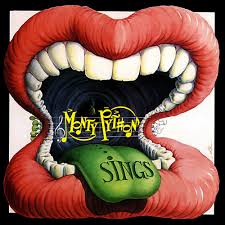
At the end of the night, gifts were handed out. There were three or four things to choose from, but I immediately honed in on something I’d never seen before–a brand new Python record album titled Monty Python Sings! It featured most of the great Python music from TV and films, collected on one piece of vinyl, under a beautiful Terry Gilliam cover. I had long been pestering the Python office to put out such an album, and here it was!

Despite knowing what a pain it would be to carry it back in my luggage, I brought it back to the States, and still remember the first time I heard it. In addition to all of the old favorites, there was one special treat. Graham had written and sang Medical Love Song for the Contractual Obligation Album (with Eric Idle) a few years earlier. But Monty Python Sings featured a new version, with additional lyrics, sung by Graham. His voice was noticibly weakened, but it was the last thing he did for Python before he died. I later found out that Eric had walked Graham through it all so that he would have one more piece of work for Python. And Eric immediately shot up to the top of the “Nicest Python List.”

Why do I bring all of this up now?

Because Monty Python Sings (Again) is being re-released on June 9, with new bonus recordings, a few long-lost gems from the Python archives, remixed Terry Gilliam cover artwork, and a special bonus disc of their very first record album, Monty Python’s Flying Circus, recorded live at Camden Town Hall in May 1970. Whether you’re going to the shows in July at the O2 Arena, or watching the final show in theatres, it’s a great way to celebrate the 45th anniversary of Python. It’ll be available on iTunes, or you can order a copy just by clicking here. Sounds like a great deal to me. Knowwhatimean?

Image

Link

Python Live Linking

The  Monty Python Live Facebook page just went live last week, and it looks like it might be a very good place to check in for occasional updates. Of course, this will, I hope, continue to be another very good place to check in for occasional updates. Why not keep using us both?

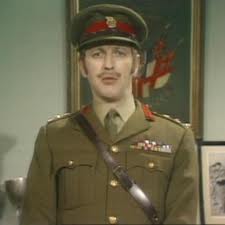
BTW, a couple of people have asked me if Terry Gilliam will be taking over Graham Chapman’s roles in this show. As I understand it…not quite. First of all, Terry and Graham are rather different types. Other Pythons may fill in for Graham in some circumstances, but there will also be clips and recordings of Graham filling in for Graham.

I should point out that while the show will include lots of favorite old sketches, there’s going to be new material, and new twists on old material. If you’ve seen or heard Monty Python Live at City Center or Monty Python Live at the Hollywood Bowl, you haven’t seen Monty Python Live (mostly). Tickets are still blah, blah, blah…

Link

Python Sings (Again)…

It’s official. There will be a reissue of the 1989 CD Monty Python Sings, with five new tracks, one of which will be launched for free on Youtube. The Pythons will also release a single in May, leading the way for the Python Reunion show in July at London’s 02 Arena.

The first time I saw the Monty Python Sings album was at the Python 20th anniversary party in London. Graham had passed away just a couple of months previously (in an unsuccessful attempt to poop this particular party), and I was delighted to learn that one of the tracks on the album was an extended version of “Medical Love Song,” which Eric had helped Graham record shortly before his death.

Monty Python Sings is, essentially, a Python Greatest Musical Hits album; if you have a favorite song from Python, there’s a pretty good chance it’s on this album. And as of May, there’s an even better chance of a brand new favorite.

Too Silly…

Graham Colonel… It was about this time of year in 1981 that Graham Chapman came through town.

I was living near Chicago, but hadn’t seen Graham for several months, not since Monty Python Live at the Hollywood Bowl shows had ended the previous fall. But Graham let me know that he was going to be in Chicago, promoting A Liar’s Autobiography, and it would be nice to get together. I agreed, and we made arrangements to meet.

Although I’d seen Graham and Terry Jones back in 1975, at the Carnegie Theatre when they were promoting Monty Python and the Holy Grail, this was the first time since then that Graham and I would be able to meet on my home turf, and I’d be able to show him around the city. In other words, it was a rare treat.

He had a full slate of interviews, and I seem to recall listening to one of them on the radio as I drove into the city. I picked him up mid-afternoon, and I might have even driven him to his last few appointments, and then we sat down and caught up.

He showed me the schedule the publicist had given him to see which of the remaining interviews were the most important. He also seemed a bit anxious about an event scheduled for that evening. It was at Facets, a Chicago film society, featuring a screening of Monty Python and the Holy Grail, followed by what was described as a talk by Graham Chapman.

“I didn’t know I was supposed to say anything,” worried Graham. I didn’t blame him. Unlike his onscreen persona, Graham was normally shy and quiet, and this seemed quite a bit to handle without a lot of advance preparation.

We talked about it further, and I tried to calm his fears. “Why don’t you just do a question and answer thing?” I suggested to him. “That should be a lot easier. Besides, they’re going to love whatever you do.” He seemed a little more comfortable at the idea of just answering questions, and I further comforted him by pointing out that Facets wasn’t that big of a place, and there probably wouldn’t be too many people. “And if there are, they probably won’t ask too many questions,” I lied.

“Yes, I suppose,” he said, wanting to believe me and a bit cheered. “That should be all right.”

The subject didn’t come up again until we pulled up at Facets that evening. Facets wasn’t that large, but the fans managed to pack themselves in every available inch. They weren’t laughing at Holy Grail as much as they were cheering, and when the film ended, Graham took his place in front of the crowd.

“Does anyone have any questions?” he asked in front of the whooping multitude. I was probably the only one who didn’t try to ask a question, but I did laugh–and cheer–along with his answers. The hosts had asked earlier if they could audiotape the session, and I told them I was sure it would be fine. About 45 minutes later, the host thanked the crowd, and Graham and I were whisked away. Even Graham was in a buoyant mood, and the rest of the evening, Graham asked me a few questions, and we relived some of the funnier moments.

I had almost forgotten about it when, a few months later, I got a call from Graham out of the blue. “Do you know if they taped that thing at the film society?” he asked. I told him I thought so, and asked if he wanted a copy of the tape. “That would be great! Thanks Howard.”

I contacted Facets, and they were happy to supply a copy of the tape, which I sent along to Graham. It was only later that I found out why he wanted it.

It seemed that someone had contacted Graham about doing a lecture tour, but Graham wanted to listen to the tape first. He was happy with it, and then sent it along to the promoter, who was delighted, as it made it very easy to get bookings for Graham.

And so, for the rest of the ’80s, Graham would go out on tour whenever he was low on cash. Which was not terribly uncommon for Graham. But it had an unexpected benefit for me as well. Whenever he toured, he tended to go through Chicago quite a bit. And, having just moved into the city itself, it meant that I was able to visit with Graham surprisingly often. We spent so much time together that would otherwise have been impossible, with more adventures than I’d ever hoped for. And thanks to the lecture tours, he saw me improvise, we went to a high school party, and my mother did his laundry. And much, much more…
Nilsson: the Book

I just finished reading the new biography of Harry Nilsson by Alyn Shipton, titled Nilsson: The Life of a Singer-Songwriter. I knew Harry, off and on, for the last 15 years of his life, but there were great gaps in my knowledge of the man, gaps that this book filled most admirably. In fact, if I had known this much about his life and times before I’d met him, I’d probably have been too intimidated to approach him.   Harry N

One bit of full disclosure. In the early 90s, he wanted to shop around his autobiography, and I helped him to put together a proposal (I met Harry through the Pythons in general and Graham Chapman in particular); to that end, he sent me what he had written up to that point. I helped him package it and helped him send it around, but there were no takers, so I sadly sent it all back. But his family held onto it long enough for Shipton to mine it for quotes and other information.

Dominating a huge portion of that life, of course, were the Beatles, particularly John and Ringo, though there are some wonderful anecdotes about Paul and George as well. It’s worth reading for that reason alone, but his life crossed so many other paths that I could scarcely believe my eyes.

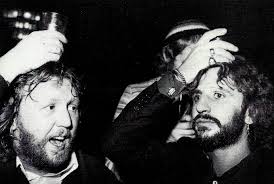
Harry & RingoHis childhood was spent shuffled from relative to relative, crossing the country alone at a frighteningly early age, until he wound up working as a bank manager. He kept that job even after he started finding success as a singer-songwriter, but shortly after he left it, the Beatles famously described him as their “favorite group.” He went on to major Grammy-winning success, but his success did not serve him well. He was a major part of John Lennon’s “lost weekend,” during which Lennon produced his “Pussycats” album, but drink and drugs took their toll on his personal life and on his amazing voice. I know people who encountered Harry during this period, and they described a different man than the Harry I knew. Of course, I knew him after he had mostly quit drinking, and that had a huge positive affect on him and his family.

During his prime, he was turning out iconic hits like “Everybody’s Talkin'” and “Without You” (both written by others), while writing songs that others made into huge hits (Three Dog Night’s “One”). But he refused to be pigeon-holed, and his albums are incredible mixtures of rockers and old standards and everything in between. Yet he prided himself for never playing live concerts, and for the most part, he remained true to that.

Nilsson does an amazing job of analyzing nearly every song he recorded (Shipton is a music writer), though I would have liked to have read more about his personal life, and his life after 1980 is given particularly short shrift. Then again, those were seemingly the saddest years for Harry, at least professionally, when his health began to suffer and his finances suffered because he trusted people he shouldn’t have trusted. I enjoyed reading Nilsson until around 1980 for that reason–then it became a little too painful. But I know the 80s were his happiest family time with his family, making up for what he never had, so I’m not sure Harry regretted them.

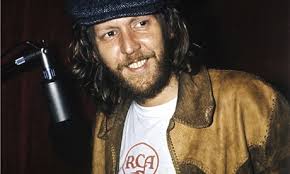
Harry 2It should also be noted that he spend time in the 80s campaigning against Handgun Violence after John Lennon was assassinated, so even though he had mostly retired from music, he stayed active. He did appear at a number of Beatles Fan Conventions and sang (usually two or three songs) to raise money for the charity. Near the end, to repair his finances for his family, he was even planning a concert tour, but his ill health prevented that from happening. And frankly, his voice was not what it had once been, either, after those years of abuse. But Harry was still Harry, and I’m sure his personality could have made up for any musical lapses.

It’s such a cliche to say that “his music lives on,” but the new episode of HBO’s Girls featured the cast dancing to Harry’s provocative “You’re Breakin’ My Heart.” He would have loved that, but I’m sure he knew he would be remembered regardless. And thanks to Nilsson: The Life of a Singer-Songwriter, I was able to spend a few more hours with Harry.

Early Pre-Python

This is one of the sketches I may be showing my iO class in the coming weeks. Known variously as “The History of Slapstick,” “The History of the Joke,” “The Custard Pie Sketch,” and probably by a few other names as well, this is probably the oldest sketch that ever made it into any of the Monty Python shows (the runner-up: probably “Four Yorkshiremen”). Written by Terry Jones and, I think, Michael Palin, long before the Pythons ever got together, it was eventually incorporated into the Python stage show, in part because the Pythons wanted to include some sketches that most of their fans hadn’t seen before. We’ll find out in July if they will include it in the O2 shows…
This version is from one of the Amnesty International Benefits. Enjoy.