Tag Archives: Improv

Goodbio iO

Time out from Python for more comedy.

io Old sign

This is the last week of the iO Theatre at its North Clark Street location, before it opens in August at its new-and-improved four-stages-no-waiting location by North Avenue and Clybourn.

It’s hard for me to be too pained by its passing (particularly because the new one is going to be so cool).

I already lost my first iO, though we called it the Improv Olympic back then, and I hardly even noticed at the time.

Crosscurrents Cabaret was just north of Belmont on Wilton, and that’s where it all started. When the Baron’s Barracudas wound up their run, I didn’t see as much of it for a while. But the iO has always wandered a bit, even when I was taking classes at Crosscurrents. It’s now been on North Clark for decades, where it has housed classrooms, stages featuring some of the best improvisation anywhere, and well as the earthly remains of Del Close. In recent years I’ve reconnected and begun teaching again, and I can see why so many are so sad to be losing it.

A few years back, I remember Dave Pasquesi pointing out a huge construction site on Wilton near Belmont. It was all gone, every scrap, and I was surprised at how little affected I was.

So I can only tell you this–I’ve lost the iO before, and it’s not about the location, it’s about the work. The iO always comes back bigger and better than before, and I have every confidence that this will be the case this time. Good work, Charna. See you at the new digs, Del.

Committee Clean-Up

By the time The Committee put out their second album, The Wide World of War, in 1973, they had just about finished their ten-year run in their own theatre (though they continued intermittently as a touring entity for a few years afterward).
In “The Clean-Up,” Del Close and Larry Hankin play junkies. Those who knew Del will tell you that this was not a great stretch. This is where you will hear one of Del’s favorite comedy lines: “You can’t sell fire, man, that’s one of the four elements!” As the scene progresses, Del’s character becomes increasingly frustrated because he no longer can find anyplace on his body to shoot up, and–well, you can listen for yourself.

How Mick Napier almost killed me…

Mick Napier, as many know, is the founder of The Annoyance Theatre, which has just re-opened at its space at Clark and Belmont in Chicago, a stoned throw away from the one-time site of Crosscurrents Cabaret, where so many of us started out.

 Image

I had been studying and performing at Crosscurrents for a while when Mick Napier came along in the mid-to-late 80s. We were all working with Del Close and Charna Halpern, who had started the ImprovOlympic not long before that. My team, the Baron’s Barracudas, was the first house team of what later became the iO, and Mick moved up through the ranks quickly.

I remember coaching one of Mick’s early teams. I also remember directing a show called “Children’s Hospital” ay nearby Sheffield’s (which is one of the few places that’s still there today), which also featured Andy Dick, among others. And Mick was one of the few non-Baron’s Barracudas (Rich Laible was the other one) to appear in “Honor Finnegan vs. the Brain of the Galaxy,” the first scripted show directed by Del after he left Second City.

Mick eventually approached me about a new project he was doing for a new theatre he was creating. He called it Metraform, and he was going to stage an ambitious, messy show he was calling “Splatter Theatre,” in the upstairs space. He wanted me to present, between acts, what we lovingly referred to as “Meat Puppets.”

 Image

It was a subtle as it sounds. I was the host, a Frazier Thomas figure to pieces of raw meat that were manipulated from below by my puppeteers (who included, if I remember correctly, Dave Pasquesi and Tim Meadows. Wonder whatever became of them?…). The storylines, as they were, usually involved some sort of infidelity between a chicken, a pork chop, and whatever other cuts of meat happened to be on sale that day. They all ended violently.

It was one of my more dangerous shows. Every night before the show, I would have to prepare the various meats (and thaw out the whole chicken–for some reason, the chicken was always at least partially frozen). The water upstairs at Crosscurrents was always as cold as the chicken, so I could never truly disinfect my hands, and salmonella was a real possibility. After each show, I tried to get to the water before the “Splatter Theatre” cast. They were all covered with chocolate syrup dyed red to look like blood, so I didn’t blame them for wanting to clean up. But I was trying to ward off salmonella, so we all jostled with each other for access to the icy water. I guess it was a draw. They got clean, and I didn’t get salmonella.

And now, many years later, after decades of success doing it his way, The Annoyance Theatre has re-launched. I don’t know what they’re going to be doing, but I know it’ll always be worth checking out. So even though you’re undoubtedly uncomfortable about all of the attention you’re getting, deal with it, Mick. It’s what comes of doing things your own way for so long. And long may you annoy.

The IBM Machine…

Avery Schreiber was a very funny actor and improviser that, despite his many talents, ultimately became best-known for his snack food commercials. But he served a tenure at The Committee and Second City, and also teamed very successfully with Jack Burns and, as Burns and Schreiber, even had their own network TV series one summer.
He was also a friend of Del Close, who is no stranger to followers of this blog. While at Second City in the early 1960s, they developed a scene in which Schreiber played a computer (then better known to audiences as an IBM Machine). Del would get a question from the audience, then feed it into Schreiber’s machine. Avery would then go into various gyrations as he tried to come up with an answer. Finally, he would spit out the answer by way of an invisible tape that Del would pull out of his mouth, and Del would then read the answer to the audience.
This generally got a great laugh from the audience and the audience was always very impressed with Avery. Of course, the person asking the question was the one who did all of the work and had to come up with the funny response, but it was a great bit.
(Avery did the human computer bit with other people over the years, most notably Jack Burns.) Here’s a clip of Close and Schreiber, disguised as a Second City documentary…

Link

Mick’s Annoyance…

Folks in the Chicago area who appreciate comedy and improvisation are outrageously lucky to have so many great opportunities to see first-rate work. The three pillars of Chicago improvisation, Second City, the iO, and the Annoyance Theatre, are all brilliant in their own slight different ways (there are many others, of course, such as Dave Sinker’s Comedy Shrine in the suburbs, which deserves a column all its own). Second City is the best known though it does less improvisation than the other two. The iO is the home of longform, and near and dear to my heart thanks to the work of Del Close and Charna Halpern. I was with the iO (then the ImprovOlympic) at nearly the beginning. I was involved with the Annoyance (then Metraform) before the beginning. The latter two are going to be opening up in brand new spaces this summer, and both are worth much more space than I have to devote to them at the moment. But, I saw this very nice article in this weekend’s Chicago Tribune about the Annoyance in general and Mick Napier in particular, so I thought I’d pass it along. I am a huge fan of Mick, and am particularly delighted that he’s become an institution, and am even more delighted that I know how uncomfortable he undoubtedly is at that particular thought. Don’t fight it, Mick. Just enjoy, and keep on doing what you’re doing.

Mafia Graduates…

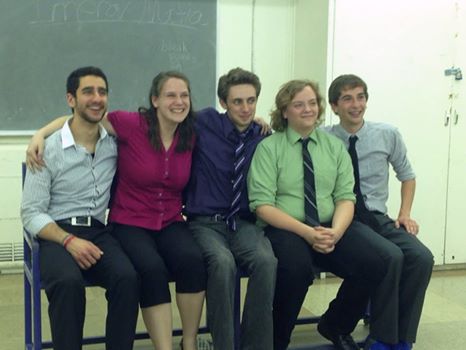
I’ve spent the past couple of school years working with the Improv Mafia at Illinois State University, and a more enthusiastic and talented band of ruffians you’ll never meet. They are true to one of the oldest improvisational maxims by making me look good with their work.

The bad part of working with college students is that every spring, you generally lose a batch of them, and you hope that in the fall, you’ll get another group just as talented and enthusiastic. So far, that’s been the case, and I have no reason to think that won’t continue. In the meantime, I wanted to salute this year’s graduating seniors: Omar, Fiona, Kyle, Robert, and Chris. Well done, all!

Image


Pure Gold

I had the honor of interviewing Herb Gold, the “Elder Statesman of the Beat Generation,” a few weeks ago for my book on the history of The Committee. He’s a San Francisco icon–hell, he’s a national treasure–who has been just about everywhere, done just about everything, and written about it. A LOT, in way more books than I can count. He was even, at one point, a roommate of my friend Del Close when the latter was appearing with the St. Louis Compass Players in the late 1950s.

Jamie Wright and Sam Shaw, who are compiling a documentary on The Committee, pointed out that there’s a great new interview with the esteemed Mr. Gold right here, and although it’s short, it’s well worth checking out.

When I interviewed him for my upcoming book, I was amazed at how clear and accurate he was about things that happened more than half a century ago. I was even more amazed when I found out that he was about to turn 90 years old. Happy birthday, Herb!


Happy Birthday Committee!

Fifty-first anniversaries are never quite as flashy as 50th anniversaries, but it’s always worth remembering the opening night of The Committee on April 10, 1963! Scott Beach, Hamilton Camp, Garry Goodrow, Larry Hankin, Kathryn Ish, accompanied by Ellsworth Milburn, stage managed by Dick Stahl, and directed by Alan Myerson, took the stage at 622 Broadway in San Francisco.

Image

(The Dick Cavett Show appearances, including the one with Janis Joplin, above, didn’t come until much later.)

Since that evening, a lot of talented folks took the stage as part of The Committee, and they influenced countless others, most of whom don’t even know it. Hopefully, Jamie Wright, Sam Shaw, and I will be able to change that in the next couple of years. Jamie and Sam, who do a terrific job producing the San Francisco Improv Fest every year, are producing a documentary on The Committee, and I’m working on my Committee book.

Anyone who has ever performed The Harold (or any other kind of longform improvisation), or been to the iO, UCB, Groundlings, The Annoyance, or so many other theatres and schools, or enjoyed the work of some of their alumni (including the much-in-the-news iO and Second City alum Stephen Colbert), owe an awful lot to these pioneers, and the upcoming documentary and book will tell you why.

Committee Report…

…I had a great time yesterday talking with Dr. Gosling Trauma, a former piano player for The Committee.

Image

He is just one of the most recent interviews I’ve done for my book on the legendary improvisational theatre. It’s taking much longer than I had hoped, but that’s partly because I keep coming across new people to interview. Just when I think I’m ready to stop interviewing and start writing, somebody else comes along. I don’t know when Jamie Wright and Sam Shaw will be finishing their documentary, either, but there’s going to be a lot of Committee greatness out there eventually…

Too Silly…

Graham Colonel… It was about this time of year in 1981 that Graham Chapman came through town.

I was living near Chicago, but hadn’t seen Graham for several months, not since Monty Python Live at the Hollywood Bowl shows had ended the previous fall. But Graham let me know that he was going to be in Chicago, promoting A Liar’s Autobiography, and it would be nice to get together. I agreed, and we made arrangements to meet.

Although I’d seen Graham and Terry Jones back in 1975, at the Carnegie Theatre when they were promoting Monty Python and the Holy Grail, this was the first time since then that Graham and I would be able to meet on my home turf, and I’d be able to show him around the city. In other words, it was a rare treat.

He had a full slate of interviews, and I seem to recall listening to one of them on the radio as I drove into the city. I picked him up mid-afternoon, and I might have even driven him to his last few appointments, and then we sat down and caught up.

He showed me the schedule the publicist had given him to see which of the remaining interviews were the most important. He also seemed a bit anxious about an event scheduled for that evening. It was at Facets, a Chicago film society, featuring a screening of Monty Python and the Holy Grail, followed by what was described as a talk by Graham Chapman.

“I didn’t know I was supposed to say anything,” worried Graham. I didn’t blame him. Unlike his onscreen persona, Graham was normally shy and quiet, and this seemed quite a bit to handle without a lot of advance preparation.

We talked about it further, and I tried to calm his fears. “Why don’t you just do a question and answer thing?” I suggested to him. “That should be a lot easier. Besides, they’re going to love whatever you do.” He seemed a little more comfortable at the idea of just answering questions, and I further comforted him by pointing out that Facets wasn’t that big of a place, and there probably wouldn’t be too many people. “And if there are, they probably won’t ask too many questions,” I lied.

“Yes, I suppose,” he said, wanting to believe me and a bit cheered. “That should be all right.”

The subject didn’t come up again until we pulled up at Facets that evening. Facets wasn’t that large, but the fans managed to pack themselves in every available inch. They weren’t laughing at Holy Grail as much as they were cheering, and when the film ended, Graham took his place in front of the crowd.

“Does anyone have any questions?” he asked in front of the whooping multitude. I was probably the only one who didn’t try to ask a question, but I did laugh–and cheer–along with his answers. The hosts had asked earlier if they could audiotape the session, and I told them I was sure it would be fine. About 45 minutes later, the host thanked the crowd, and Graham and I were whisked away. Even Graham was in a buoyant mood, and the rest of the evening, Graham asked me a few questions, and we relived some of the funnier moments.

I had almost forgotten about it when, a few months later, I got a call from Graham out of the blue. “Do you know if they taped that thing at the film society?” he asked. I told him I thought so, and asked if he wanted a copy of the tape. “That would be great! Thanks Howard.”

I contacted Facets, and they were happy to supply a copy of the tape, which I sent along to Graham. It was only later that I found out why he wanted it.

It seemed that someone had contacted Graham about doing a lecture tour, but Graham wanted to listen to the tape first. He was happy with it, and then sent it along to the promoter, who was delighted, as it made it very easy to get bookings for Graham.

And so, for the rest of the ’80s, Graham would go out on tour whenever he was low on cash. Which was not terribly uncommon for Graham. But it had an unexpected benefit for me as well. Whenever he toured, he tended to go through Chicago quite a bit. And, having just moved into the city itself, it meant that I was able to visit with Graham surprisingly often. We spent so much time together that would otherwise have been impossible, with more adventures than I’d ever hoped for. And thanks to the lecture tours, he saw me improvise, we went to a high school party, and my mother did his laundry. And much, much more…