Improv Mafia

I spent Saturday afternoon workshopping the Improv Mafia, the improv group at Illinois State University, an old dog trying to teach these kids some new tricks. Fortunately, everything old is new again, eventually, and I kept remembering tricks and exercises from many years ago that seemed to work pretty well. I also, in the spirit of Del Close, made up a few exercises that I though would be beneficial to them (though we only had time to work on a couple of them–time flies when you’re improvising).

Image

Next Saturday are the finals for the College Improv Tournament, which is organized by my old pal Jonathan Pitts (here’s the info). The top 16 college improv teams in the U.S. will be competing for the national championship in Chicago. These are the regional champions who have advanced from the over 100 teams that competed across the country.

Many years ago, Del and Charna Halpern organized what may have been the first college improv tournament. If I remember correctly, there were three teams competing–the Yale Purple Crayon, and two Chicago-area teams. And now, there are hundreds of college teams alone, competing for a real national championship for the seventh year in a row. 

Good luck to all the improvisers. And if the Improv Mafia wins, and I try to claim as much credit as possible, just ignore me.

Image

Python Rarities

Here’s another selection of outtakes from MONTY PYTHON’S FLYING CIRCUS. These are from Episode 39, the final episode with John Cleese in the cast. Lots of Michael Palin hosting “Grandstand,” a few cricketers, and “wifeswapping,” with Michael Palin in bed with John Cleese. Enjoy.

Cleese Still Down Unda…

When I started doing this last fall, one of my very first posts was about John Cleese and his one-man show during his Canadian tour. At that time, I mentioned that he would be touring Tasmania and Australia at the beginning of 2014. That would be now.

Image

So, if you currently find yourself in that corner of the world, you will want to check out John’s show. As I write this, he’s performing in Tasmania, but will be back in Sydney for three weeks starting Monday, followed by six shows in Melbourne. Most of these are sold out, but if you act quickly, you may be lucky enough to score a few of the remaining seats if you click here.

You’re welcome.


Nilsson: the Book

I just finished reading the new biography of Harry Nilsson by Alyn Shipton, titled Nilsson: The Life of a Singer-Songwriter. I knew Harry, off and on, for the last 15 years of his life, but there were great gaps in my knowledge of the man, gaps that this book filled most admirably. In fact, if I had known this much about his life and times before I’d met him, I’d probably have been too intimidated to approach him.   Harry N

One bit of full disclosure. In the early 90s, he wanted to shop around his autobiography, and I helped him to put together a proposal (I met Harry through the Pythons in general and Graham Chapman in particular); to that end, he sent me what he had written up to that point. I helped him package it and helped him send it around, but there were no takers, so I sadly sent it all back. But his family held onto it long enough for Shipton to mine it for quotes and other information.

Dominating a huge portion of that life, of course, were the Beatles, particularly John and Ringo, though there are some wonderful anecdotes about Paul and George as well. It’s worth reading for that reason alone, but his life crossed so many other paths that I could scarcely believe my eyes.

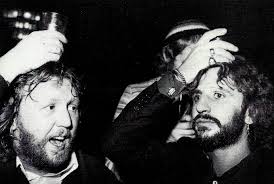
Harry & RingoHis childhood was spent shuffled from relative to relative, crossing the country alone at a frighteningly early age, until he wound up working as a bank manager. He kept that job even after he started finding success as a singer-songwriter, but shortly after he left it, the Beatles famously described him as their “favorite group.” He went on to major Grammy-winning success, but his success did not serve him well. He was a major part of John Lennon’s “lost weekend,” during which Lennon produced his “Pussycats” album, but drink and drugs took their toll on his personal life and on his amazing voice. I know people who encountered Harry during this period, and they described a different man than the Harry I knew. Of course, I knew him after he had mostly quit drinking, and that had a huge positive affect on him and his family.

During his prime, he was turning out iconic hits like “Everybody’s Talkin'” and “Without You” (both written by others), while writing songs that others made into huge hits (Three Dog Night’s “One”). But he refused to be pigeon-holed, and his albums are incredible mixtures of rockers and old standards and everything in between. Yet he prided himself for never playing live concerts, and for the most part, he remained true to that.

Nilsson does an amazing job of analyzing nearly every song he recorded (Shipton is a music writer), though I would have liked to have read more about his personal life, and his life after 1980 is given particularly short shrift. Then again, those were seemingly the saddest years for Harry, at least professionally, when his health began to suffer and his finances suffered because he trusted people he shouldn’t have trusted. I enjoyed reading Nilsson until around 1980 for that reason–then it became a little too painful. But I know the 80s were his happiest family time with his family, making up for what he never had, so I’m not sure Harry regretted them.
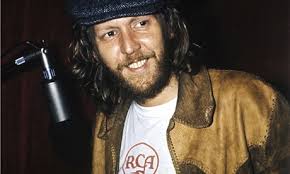
Harry 2It should also be noted that he spend time in the 80s campaigning against Handgun Violence after John Lennon was assassinated, so even though he had mostly retired from music, he stayed active. He did appear at a number of Beatles Fan Conventions and sang (usually two or three songs) to raise money for the charity. Near the end, to repair his finances for his family, he was even planning a concert tour, but his ill health prevented that from happening. And frankly, his voice was not what it had once been, either, after those years of abuse. But Harry was still Harry, and I’m sure his personality could have made up for any musical lapses.

It’s such a cliche to say that “his music lives on,” but the new episode of HBO’s Girls featured the cast dancing to Harry’s provocative “You’re Breakin’ My Heart.” He would have loved that, but I’m sure he knew he would be remembered regardless. And thanks to Nilsson: The Life of a Singer-Songwriter, I was able to spend a few more hours with Harry.

Harried…

I had planned to post my comments on the new Harry Nilsson biography over the weekend, but the weather continues to be atrocious and life has continued to interrupt. I want to be thorough, so I had to delay it. There’s currently another blizzard/ice storm raging outside, so it’s going to have to wait a little longer. In the meantime, I thought a nice Harry video might be just the thing. And yes, that’s really Harry in one of the gorilla suits.

Robocop and Me

I will be checking out the remake of Robocop that opened this week. I have a personal relationship with Robocop–the original one, that is–and I want to see how this one compares.

RobocopBack in the Golden Age of Starlog magazine, I used to go on one or two visits to film sets every year. Some of them were for terrific movies (Cocoon, The Dark Knight), while others were–well, not so special. But there was usually something to recommend each one of them–if not the film, then the company I’d keep (I first met Greg Nicotero on a mostly forgettable movie filming in Oregon–I won’t mention the name, but a hearty handshake to you if you can figure it out. Wonder what Greg’s doing now?).

But for some reason, my editor and pal (not necessarily in that order) Dave McDonnell picked me to send to Dallas, where the first Robocop was filming with Peter Weller, Nancy Allen, and an all-around terrific cast and crew. I even had the opportunity to walk around a bit, as my hotel was fairly close to Dealey Plaza (the JFK assassination site). I interviewed director Paul Verhoeven, who made what could have been an exploitative action flick into a brilliant bit of social commentary, as well as Peter Weller, though he wasn’t in the Robosuit at the time. We were on the upper floor of a steel and glass building where they were filming a boardroom scene, and we got to see the huge ED-209 life-sized model that would play a large part in that particular scene.

Although I’ve been on dozens of film sets, for some reason I have a hard time remembering many of the scenes where I was present–not just for Robocop, but for more than half of them. I don’t remember what I saw them filming for Robocop 2 and Robocop 3, though if I read the subsequent articles in Starlog, I’m sure they’d come to mind.

Instead, I remember little things, like Peter Weller gushing over the man who coached his movements, and whom he generously credited with helping him create the character. Weller did the two films and was then replaced in Robocop 3 by Robert John Burke, a talented actor and all around nice guy. In fact, after I got home, I received a thank-you postcard from him. Of the hundreds of people I’ve interviewed, he’s still the only one who ever sent me a thank you. Not that I expect it, or do it because I’m looking for a thank you, but hey–what a classy gesture.

And so, I’ll be watching the newest iteration of the cyborg lawman with great interest, and I wish them luck. But the original Robo–well, we’ll always have Dallas.

RIP Sid Caesar

There’s not much I can add to what so many others have written about the death of Sid Caesar since his death was announced. A genius? Yes. Brilliant? Of course.

Image

I only met him one time, briefly, and of course it involved Monty Python. In 1994, I was attending a party celebrating the 25th Anniversary of Monty Python at the British Consulate in L.A. It was an outdoor affair, a garden party, and as is usual for these sort of things, there were a number of celebrities, some undoubtedly Python Fans, and others having very interest in Python. Eric Idle, Terry Gilliam, Terry Jones, Carol Cleveland, and Neil Innes were there representing Python. The press had turned out, and set up interviewing areas. A number of them were swarming around Richard Pryor, who was holding court in his wheelchair on a small makeshift stage. The Pythons themselves were more low-key, usually speaking to reporters one-on-one.

I ran into Andy Dick, who was a friend from Chicago, and we were catching up and name-checking some of our other mutual friends. Suddenly, in the middle of a story, Andy stopped and gasped “Oh my God, there’s Sid Caesar!” I turned and saw a tall, elderly man apparently wandering by himself. Andy and I scurried over to him and gushed a bit, expressing our admiration for the man and his work. Caesar looked a bit tired but grateful and thanked us. I was called away, but Andy remained, singing his praises to the legend himself. At that time, I think Andy had done NewsRadio, but it was before he had gone through his now well-known rough patch with drugs and alcohol, so he was a respected TV comedy figure. Whether Caesar even had a clue as to who Andy was, I don’t know. But I had the feeling that Caesar heard this a lot, and while he appreciated it no matter who it came from, he was also a little bored and frustrated because he was working very little. He looked old and tired, but managed to live another twenty years clean and sober, which for him, probably meant a lot.

A few minutes later, Andy ran over to me excitedly. “That was Sid Caesar! We just talked to Sid Caesar!” he gushed. While Caesar had probably forgotten both of us by that time, I think it’s something that both Andy and I will remember.

iO Python Process Class Part 2

The final session of my first iO writing class wrapped up last night with a staged reading of a half-hour show we cobbled together from the various sketches the students have been writing and co-writing in the same process that the Pythons used to put together their shows. It went even better than I had hoped, especially considering the degree of difficulty involved.

It occurred to me that we managed to do in four three-hour sessions what would normally require twice as many sessions. But despite the breakneck pace, they acquitted themselves very well. Although it would have been nice to have a bit more time for polish, they were amazing, especially considering that four weeks ago, none of them knew each other, but managed to collaborate enough to produce a half-hour program.

But even the short schedule, I think, was beneficial. As I told them last night, most writers have virtually their whole life to come up with and polish their first portfolio of sketches or their first TV spec script. But if they get hired, they often have one week to produce their second one. There’s not a lot of ways to train for that. Hopefully, my students are a little better equipped than they were four weeks ago.

We even had time to watch the very first episode ever filmed of Monty Python’s Flying Circus, to give them some ideas about sequencing sketches, so I decided to post one that got a lot of laughs. Enjoy.

iO Python Process class

Tonight is the final session of my iO Chicago Python Process class. I’m going to miss this a lot! The group is busily polishing sketches and tonight we’ll decide on a running order and do a reading with a few invited guests. If my students are having as much fun as I am, I’m going to have to organize another one of these very soon.

We’ve been watching videos, writing, and discussing re-writes and they’ve been learning collaboration a la Python. I’ll let you know how it goes.